Our Research
Our lab
focuses on Translational Research in Gastroenterology. We apply skills in
Mucosal Immunology to relevant clinical questions, derived from tight
collaboration and interaction with the
Division of Gastroenterology, Rabin Medical Center (https://hospitals.clalit.co.il/rabin/he/departments-and-clinics/gastroenterology/Pages/gastroenterology.aspx(. Our primary field of interest is studying immune homeostatic
responses in the intestinal mucosa. How does the intestinal epithelium respond
to commensal flora (bacteria, fungi) and consequently activates the intestinal
immune system. We identified genetic, molecular, microbial, serologic, immune,
nutritional and environmental factors associated with intestinal inflammation.
Specifically, we focus on inflammatory pathways developing in patients
undergoing total proctocolectomy and ileal pouch anal anastomosis
reconstruction (pouch surgery) and those with early inflammatory bowel disease.
We aim to expand our mechanistic understanding of intestinal responses to commensal
flora, nutritional choices and biological therapies. We use our biomaterial
repository (collected in a longitudinal and multidisciplinary approach) in
order to gain meaningful and clinically relevant information regarding
inflammatory pathways and ways to modify/manipulate them so that IBD can be
prevented, better treated, and even cured.
Biomarker-based multidisciplinary
team (Bio-MDT) approach to personalized microbial-targeted treatment of
pouchitis and Crohn's disease
Commensal fungi and their cell wall β-glucans direct differential
response in human intestinal epithelial cells, suggesting a mechanism for
mucosal tolerance.
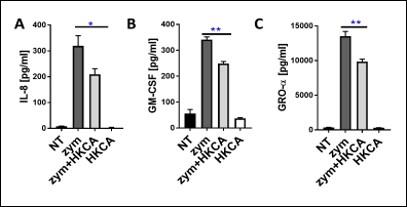
Heat-killed C. albicans interferes with zymosan induced cytokine
secretion. SW480 (A,B) and HT-29 (C) cells were stimulated with zymosan, heat killed C.
albicans (HKCA), or both, for 20 hours. Cytokine concentration in the
supernatants was assessed. *p<0.05; **p<0.01 vs. zymosan.
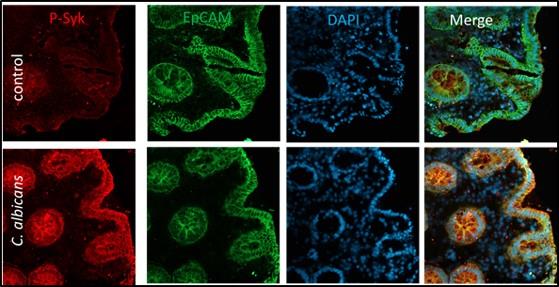
C. albicans induced Syk
phosphorylation in the normal human colonic epithelium. Human colonic mucosal
explants were stimulated ex-vivo with heat-killed C. albicans. Frozen
sections were stained with antibodies against phospho-Syk (red) or the
epithelial marker EpCAM (green) as well as nuclear counterstain with DAPI
(blue).
· Human intestinal epithelial cells respond to commensal fungi by
autophagy and LC3-associated phagocytosis
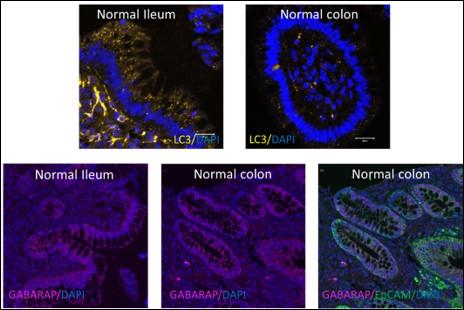
Active autophagy may be monitored in human intestinal mucosal sections.
Paraffin embedded mucosal sections from human ileum and colon of the same
individual were stained with Ab against LC3 and GABARAP (yellow and pink
pseudo-colors respectively) as well as with the epithelial marker EpCAM.
Magnification x20 (LC3 stained images: zoom x2)
· The JAK inhibitor-tofacitinib inhibits signaling pathways ex-vivoand has functional implications in human intestinal mucosa.
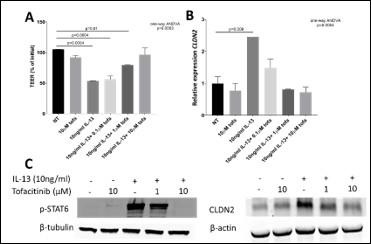
Tofacitinib prevented IL-13-induced decrease in TEER and increase
Claudin2 levels. Polarized T84 cells were treated with Tofa at the indicated concentrations apically for 1
hour prior to basolateral administration of IL-13 (100ng/ml) for 24 hours.
Cells permeability was assessed by TEER measurements, expressed as a
percentage of initial values (A). CLDN2 mRNA levels was
determined by quantitative real-time PCR (B). p-STAT6 and
CLDN2 protein expression were assessed by Western Blot
Mucosal barrier
alterations in inflammatory bowel diseases (IBD), specifically mucin
characteristics, modifying factors and specific markers in the mucosa of
patients with pouches.
Mucus
production can be analyzed in human intestinal mucosal sections. Paraffin
embedded mucosal sections from human ileum were stained with Ab against MUC2
and EpCAM (green and red pseudo-colors respectively). Magnification x20.
Predominantly antibiotic-resistant intestinal microbiome persists
in patients with pouchitis who respond to antibiotic therapy
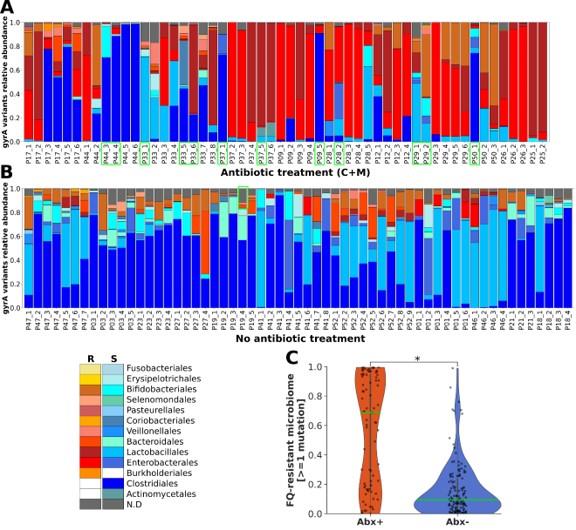
Inferred fluoroquinolones (FQ) resistance of the microbiome in patients over time. The analysis is based on point mutations in gyrA alleles for each bacterial genus, summarized to the order level; "R” signifies that all members carry at least one gyrA mutation (a resistant allele), while "S” signifies that all members carry the sensitive allele; orders marked in white were below detection. Relative abundance of gyrA variants during: (A) Ciprofloxacin and metronidazole treatment (C+M); (B) no antibiotic treatment. Green boxes indicate samples taken during a pause in antibiotic treatment of over 30 days. The plot includes 23 patients (113 longitudinal samples). (C) The total FQ-resistant fraction (at least 1 mutation) of the microbiome across all samples (assembled metagenomes, n=215) in Abx+ and Abx- groups; *P=1.4x10⁻¹³, Mann-Whitney test.